把研究当作乐趣的艺术,正逐渐失传
文明的文学基础 The Literary Foundations of Civilisation
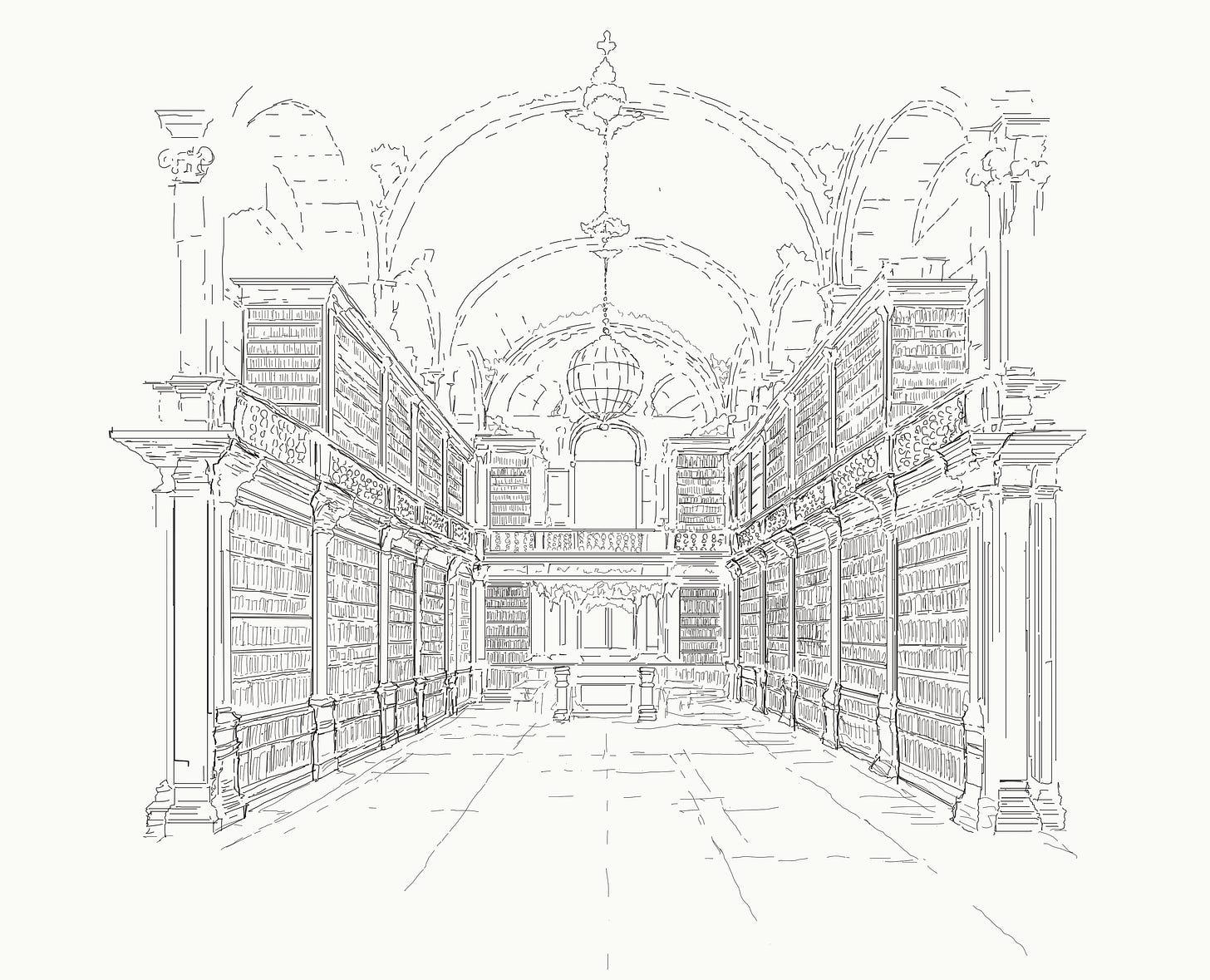
Nestled in a café-bar-museum-event space in Fort Mason — San Francisco’s water-front, weathered military campus with sweeping views of the Golden Gate Bridge —is a floor to ceiling library housing the Long Now Foundation’s Manual for Civilisation. A crowd-curated collection of the 3,500 books “most essential to sustain or rebuild a civilisation,” the Manual for Civilisation began with one question: If you were stranded on an island (or small hostile planetoid), what books would you want to have with you?
在旧金山滨水区饱经风霜的军事基地梅森堡,坐拥金门大桥壮丽景色,一座集咖啡馆、酒吧、博物馆和活动空间于一体的场所内,隐藏着一座从地板延伸至天花板的图书馆,馆内珍藏着“长远基金会”的 《文明手册》。 这本由公众共同策划的《文明手册》收录了 3500 本“对维持或重建文明至关重要”的书籍,其创作缘起于一个问题:如果你被困在一座岛屿(或一颗小型敌对行星)上,你会希望随身携带哪些书籍?
The collection, displayed along industrial walls, is both solemn and optimistic, earnest and futile, a romantic’s bookish Golden Record. It is, most vividly, a humbling monument to historian Barbara Tuchman’s proclamation that “Books are the carriers of civilisation.” “Without books,” Tuchman wrote, “the development of civilisation would have been impossible.”
这批沿着工业风格墙壁陈列的藏书,既庄严肃穆又充满希望,既真挚诚恳又徒劳无功,宛如浪漫主义者的“金唱片”。它最生动地体现了历史学家芭芭拉·塔奇曼的名言:“ 书籍是文明的载体 。”塔奇曼写道:“没有书籍,文明的发展是不可能的。”
Linking civilisation and human culture to books, reading and writing is not unique to Tuchman.
将文明和人类文化与书籍、阅读和写作联系起来,这并非塔赫曼独有的观点。
Writing nearly 350 years earlier, Galileo had declared books “the seal of all the admirable inventions of mankind,” because books allow us to communicate through time and place, and to speak to those “who are not yet born and will not be born for a thousand or ten thousand years.”
早在 350 年前,伽利略就宣称书籍是“ 人类所有伟大发明的印记 ”,因为书籍使我们能够跨越时间和空间进行交流,并与“尚未出生,且在一千年或一万年内也不会出生的人”交谈。
A few generations later, Henry David Thoreau, writing in the seclusion of Walden Pond, wrote that “books are the treasured wealth of the field and the fit inheritance of generations and culture.”
几代人之后,亨利·大卫·梭罗在瓦尔登湖畔的隐居生活中写道:“书籍是知识原野中最珍贵的财富,是世代与文化所应承袭的遗产。”
The following generation, Carl Sagan, after taking his TV audience on a journey through the cosmos, found himself alone in a library, circling back to Galileo. With the Cavatina — one of two Beethoven songs floating in space on the Voyager II’s Golden Record — playing, Sagan marvelled at the existence of books. “Writing,” he says, “is perhaps the greatest of human inventions, binding together people who never knew each other, citizens of distant epochs.” “A book,” he concludes, “is proof that humans are capable of working magic.”
下一代科学家卡尔·萨根在带领电视观众进行了一次宇宙之旅后,独自一人来到图书馆,开始研究伽利略的著作。伴随着贝多芬的《卡瓦蒂娜》(旅行者 2 号金唱片中两首太空歌曲之一)的播放,萨根惊叹于书籍的存在。“写作,”他说,“或许是人类最伟大的发明,它将素未谋面的人们,来自遥远时代的人们联系在一起。”他总结道:“一本书,证明了人类拥有创造奇迹的能力。”
Tuchman’s platitude, then, has persisted through the centuries: Books carry civilisation. Not because they are inherently sacred objects of inherently sacred knowledge, but because reading and writing assemble and shape culture. And without culture, there is no civilisation.
因此,塔奇曼的这句老生常谈流传至今:书籍承载着文明。这并非因为书籍本身就是神圣的,承载着神圣的知识,而是因为阅读和写作能够构建和塑造文化。而没有文化,就没有文明。
阅读的神圣诫命 The Divine Command to Read
In Arabic, the root word for civilisation — ح-ض-ر: to be present, to settle, to remain — expresses a profound shift from wandering to dwelling. For Islam, that shift began with a search at the boundary between city and desert.
在阿拉伯语中,“文明”一词的词根——ح-ض-ر(意为存在、定居、停留)——表达了一种从漂泊到定居的深刻转变。对伊斯兰教而言,这种转变始于对城市与沙漠交界处的探索。
1,450 years ago, looking down at the Kaaba from 2,000 feet up, and over two miles away, a wanderer in search of a spiritual dwelling was commanded to Read. The Prophet Muhammad ﷺ responded, “I am not a reader.” He was commanded again, Read.
1450年前,一位寻求精神居所的旅人从2000英尺高处俯瞰两英里外的克尔白,被命令去阅读。先知穆罕默德(愿主福安之)回答说:“我不读书。”他再次被命令去阅读。
Again the Holy Prophet responded, “I am not a reader.” The command came once more.Read in the Name of your Lord who created.
圣先知再次回答说:“我不是诵读者。”命令再次降临: 奉创造万物的主的名义诵读。
So much has been said about Islam’s origin story — codified through humanity’s most rigorous and sophisticated system of oral preservation — that one hesitates to reference it in an essay about reading.
关于伊斯兰教的起源故事——通过人类最严格、最复杂的口头保存系统编纂而成——已经有很多说法,以至于在一篇关于阅读的文章中,人们会犹豫是否要提及它。
Yet, it is with this divine command that the God of Abraham, Moses and Jesus began the story of Islamic civilisation.Read in the Name of your Lord who created.
然而,正是凭借这神圣的诫命,亚伯拉罕、摩西和耶稣的上帝开启了伊斯兰文明的篇章。 奉创造万物的主的名诵读。
在孤独与社群之间 Between Solitude and Community
To command an unlettered man to Read unsettles the essential pillar that reading is largely, or exclusively, the one dimensional act of decoding printed symbols.
命令一个不识字的人去阅读,动摇了阅读的基本支柱,即阅读在很大程度上或完全是解码印刷符号这一单一维度的行为。
The Arabic word, “Iqra,” often translated as to “read” contains a curious ambiguity — it simultaneously means “to read” and “to recite.” To recite is to engage in a primarily oral act, externally expressive.
阿拉伯语单词“Iqra”常被译为“阅读”,但它包含着一种奇特的歧义——它同时指“阅读”和“背诵”。背诵主要是一种口头行为,一种外在的表达方式。
To read is to engage in something more private and solitary, internally reflective.
阅读是一种更私密、更孤独、更具内在反思性的活动。
The Read of Islam’s originating verse embodies, as Alan Jacobs succinctly puts it in Pleasures of Reading in the Age of Distractions, “a moving between the solitary encounter and something more social.
正如艾伦·雅各布斯在《分心时代的阅读乐趣》一书中简洁地指出的那样,伊斯兰教的起源诗句体现了“在孤独的相遇和更具社交性的事物之间的转变”。
” In the context of modern reading, social can be anything — a journal entry, a blog post, a book club, a literary salon, a dignified virtual debate, a letter to a friend — because, Jacobs writes, “every good idea ever achieved is the product of both connection and contemplation, of moving back and forth between the two.
在现代阅读的语境中,“社交”可以是任何东西——日记、博客文章、读书俱乐部、文学沙龙、一场体面的虚拟辩论、给朋友的一封信——因为,正如雅各布斯所写,“每一个好的想法都是联系和思考的产物,是两者之间来回转换的结果。
” “
If reading does not flow outward to build and contribute to the living networks of human knowledge, the divine command to Read feels hamstrung, unfulfilled.
如果阅读不能向外流动,去构建和贡献于人类知识的鲜活网络,那么阅读的神圣诫命就会显得束手束脚,无法实现。
Reading alone however — even with its duality — is not enough. The Quran’s command to read has a direction.
然而,仅仅阅读——即便阅读本身具有双重性——也是不够的。《古兰经》命令人们阅读是有方向的。
Read in the Name of Your Lord who Created. Created humans from a clinging clot. Read! And your Lord is the Most Generous, Who taught by the pen—taught humanity what they knew not.
奉你的创造主的名义诵读!他用血块创造了人类。诵读吧!你的主是最慷慨的,他用笔教导人类,教给他们他们所不知道的。
The command to Read in the name of our Creator confers — as Rebecca Elson put in “We Astronomers,” a poem about resisting disenchantment — a “responsibility to awe.” The Quranic Read could be interpreted as a responsibility to awe.
奉造物主之名诵读的诫命赋予了我们一种“敬畏的责任”,正如丽贝卡·埃尔森在关于抵制幻灭的诗作《我们天文学家》中所写的那样。诵读《古兰经》可以被解读为一种敬畏的责任。
It is an invitation to learn with both disciplined inquiry, and receptive wonder.
它邀请我们以严谨的探究精神和开放的好奇心去学习。
最后一位读者的漫长世纪 The Long Century of the Last Reader
Over the last century, our responsibility to awe has been a source of anxiety.
上个世纪以来,我们对敬畏的责任一直是焦虑的根源。
In 1926 — the year the radio, a dizzying new addition to the American home, brought the World Series to living rooms across the country; the year Bell Telephone perfected transcontinental calls from New York to San Francisco for $18; the year the Orpheum Theatre opened in Los Angeles, its legendary neon sign still shining today—Virginia Woolf worried about the future of reading.
1926 年——收音机作为美国家庭令人眼花缭乱的新成员,将世界大赛带到了全国各地的客厅;贝尔电话公司完善了从纽约到旧金山的跨大陆电话,费用为 18 美元;洛杉矶的奥菲姆剧院开业,其传奇的霓虹灯招牌至今仍然闪耀——那一年,弗吉尼亚·伍尔夫担忧着阅读的未来。
In the August 3, 1926 edition of The New Republic, Woolf, comparing cinema to reading, is unsettled and nearly disgusted by the horror of the cinema. The cinema, she writes, and the pleasure we derive from it, emanates from an impulse so unrefined in its humanity, it is anti-civilisational.
在1926年8月3日出版的《新共和》杂志上,伍尔夫将电影与阅读进行比较,她对电影的恐怖之处感到不安,甚至近乎厌恶。她写道,电影以及我们从中获得的快感,源于一种人性如此原始、如此粗鄙的冲动,以至于它是反文明的。
Woolf, the quintessential sombre optimist who famously wrote that “the future is dark, which is the best thing the future can be, I think” in January 1915, does not go so far as to condemn the future of reading, but she concludes the audio-visual dangerously erodes depth.
伍尔夫是一位典型的忧郁乐观主义者,她曾在 1915 年 1 月写道:“未来是黑暗的,我认为这是未来最好的状态。”她虽然没有彻底否定阅读的未来,但她认为视听技术会危险地削弱阅读的深度。
25 years later, in 1951 — the year I Love Lucy debuted, replacing the family radio with a wooden TV box set; the year of House Un-American Activities Committee; the year of the first nuclear tests in the Nevada desert; the last year before the death of technicolour in 1952 — E.B.
25 年后,1951 年——《我爱露西》首播之年,家用木制电视机取代了收音机;众议院非美活动调查委员会成立之年;内华达沙漠首次核试验之年;彩色电视在 1952 年消亡前的最后一年——EB
White, beloved children’s book author ofCharlotte’s Web and Stuart Little, worries about the future of reading.
深受喜爱的儿童读物作家,著有 《夏洛的网》 和 《精灵鼠小弟》等作品的艾玛·怀特 ,对阅读的未来感到担忧。
In the New Yorker’s “Talk of the Town,” White reflected on the Rollins College President’s prediction that “in fifty years, only five percent of the people in the country will be reading.
在《纽约客》的“城中热议”栏目中,怀特反思了罗林斯学院院长的预测:“五十年后,全国只有百分之五的人会读书。”
White writes, “to us, it would seem that even if only one person out of a hundred and fifty million should continue as a reader, he would be the one worth saving, the nuclear around which to found a university.
怀特写道:“在我们看来,即使一亿五千万人中只有一人继续做读者,他也是值得拯救的人,是建立一所大学的核心人物。
This ‘impossible person,” this “Last Reader,” is the “queen bee,” from whom a “new race of men, linked perfectly with the long past by the broken chain of their intellect, to carry on the community.
这个“不可能的人”,这个“最后的读者”,是“蜂后”,从她那里诞生了“一群新的人类,他们通过断裂的智力链条与遥远的过去完美地联系在一起,以延续这个群体”。
” He concludes that it is more likely the race will perpetuate “through audiovisual devices, which ask no discipline of the mind, and which are already giving the room the languor of an opium parlor.
他总结说,这种竞争更有可能通过视听设备延续下去,“这些设备不需要任何精神约束,而且已经让房间变得像鸦片馆一样慵懒。”
” “
45 years later, in 1996 — the year Fox News launched on satellite television; the year Dolly was cloned; the year of the “miniature telephone”; of dial-up, the “mouse” and “keyboard”, “www” and “@”; the last year before Amazon would change the Internet — Susan Sontag worries about the future of reading.
45 年后,1996 年——福克斯新闻在卫星电视上开播的那一年;多莉被克隆的那一年;“微型电话”诞生的那一年;拨号上网、“鼠标”和“键盘”、“www”和“@”出现的那一年;亚马逊改变互联网之前的最后一年——苏珊·桑塔格开始担忧阅读的未来。
In a letter to Jorge Luis Borges ten years after his death, Sontag apologised to her old friend: “I’m sorry to tell you that books are now considered an endangered species.
在豪尔赫·路易斯·博尔赫斯去世十年后,桑塔格在给这位老朋友的信中道歉:“很遗憾地告诉你,书籍现在被认为是一种濒危物种。”
” By books, she means not the book itself, but “the conditions of reading that make possible literature and its soul effects.” Soon, “we will call up on ‘bookscreens’ any ‘text’ on demand, and will be able to change its appearance, ask questions of it, ‘interact’ with it.
她所说的“书”指的不是书本身,而是“使文学及其精神影响成为可能的阅读条件”。不久之后,“我们将能够按需在‘书屏’上调出任何‘文本’,并能够改变它的外观,向它提问,并与之‘互动’。
” Sontag’s conclusion threads White and Woolf’s fears of decades past, “when books become ‘texts’ that we ‘interact’ with…the written word will have become simply another aspect of our advertising-driven televisual reality.
桑塔格的结论与怀特和伍尔夫几十年前的担忧一脉相承,“当书籍成为我们与之‘互动’的‘文本’时……文字将仅仅成为我们受广告驱动的电视现实的另一个方面。
” It will mean, she declares, not only the death of the book, but “nothing less than the death of inwardness.”
她宣称,这不仅意味着书籍的消亡,而且“ 无异于内心世界的消亡 ”。
For nearly 100 years — each year, the future arriving faster than we have been able to process it — we have worried about the future of reading. Yet, none of these writers, nor Harold Bloom in How to Read and Why, nor Mortimer J. Adler and Charles Van Doren in How to Read a Book, nor Neil Postman in Amusing Ourselves to Death, predicted the future that arrived: an uncanny valley, neither in “orality” nor “literacy”—surrounded by more books, more words, more reading and writing than perhaps at any time in history, yet lacking a coherent culture.
近百年来——未来每年都以我们难以承受的速度到来——我们一直担忧阅读的未来。然而,无论是这些作家,还是哈罗德·布鲁姆在《 如何阅读及其意义》 中 ,莫蒂默·J·阿德勒和查尔斯·范·多伦在 《如何阅读一本书》 中 ,亦或是尼尔·波兹曼在 《娱乐至死》中, 都未能预见到如今到来的未来:一个既非“口头传统”也非“书面传统”的怪诞谷 ——我们被比历史上任何时期都多的书籍、文字、阅读和写作所包围,却缺乏一个连贯的文化。
Woolf, White and Sontag foresaw the corrosive, savage effect of the “audio-visual” on the human brain and soul.
伍尔夫、怀特和桑塔格预见了“视听”对人类大脑和灵魂的腐蚀性和野蛮影响。
They did not worry about the disappearance of books, but about the cultural collapse that would occur when reading shifts from an immersive, contemplative act to something passive, fragmented and superficial. The death of reading was not a loss of books, but a loss of culture.
他们担忧的并非书籍的消失,而是当阅读从一种沉浸式、沉思式的行为转变为一种被动、碎片化和肤浅的行为时,将会发生的文化崩溃。阅读的消亡并非书籍的消失,而是文化的消亡。
危机中的文化 A Culture In Crisis
These fears have not been unfounded.
这些担忧并非毫无根据。
Today, we find ourselves in precisely the cultural crisis that Woolf, White, and Sontag anticipated—not a world without books, but a world where fragmented attention and superficial engagement have eroded the foundations of shared meaning and cultural coherence.
今天,我们发现自己正处于伍尔夫、怀特和桑塔格所预言的文化危机之中——不是一个没有书籍的世界,而是一个注意力分散、热衷于参与肤浅活动的世界,这种分散和肤浅的参与已经侵蚀了共同意义和文化连贯性的基础。
The definition of “culture” is as liquid as the phenomenon it seeks to describe. In Princes and Powers, James Baldwin observes that only a culture in crisis would ask for a definition of “culture.”
“文化”的定义如同它试图描述的现象一样, 具有流动性 。詹姆斯·鲍德温在 《君主与权力》 中指出,只有处于危机中的文化才会要求对“文化”进行定义。
We are a culture in crisis. We lack, as Byung-Chul Han articulates in The Disappearance of Rituals, the structures and forms that make meaning possible, leading to cultural fragmentation. The result is a sense of civilisational ADHD. A generational restlessness, inattentiveness, and excessive movement in no direction, with insight elusive and ephemeral.
我们身处危机之中。正如韩炳哲在 《 仪式的消失》一书中所阐述的,我们缺乏那些使意义得以存在的结构和形式,导致文化碎片化。其结果是一种文明的注意力缺陷多动症:一代又一代的躁动不安、注意力涣散、漫无目的的过度运动,而洞察力却难以捉摸,转瞬即逝。
研究即休闲:埃利奥特和派珀论文化复苏 Research as Leisure: Eliot and Pieper on Cultural Recovery
For T.S. Eliot, writing in post-World War II England, “culture” is a mutually dependent hierarchy of three “senses”— the individual, the group, and society — that manifest in creating “the pattern of society as a whole.
对于二战后英国的 T.S. 艾略特来说,“文化”是三种“感觉”(个人、群体和社会)相互依存的等级制度,它们体现在创造“整个社会的模式”中。
” With the fragmentation of any one sense from the other - the individual from the group, the group from society — “higher civilisation is unlikely to be found.
“如果任何一种感觉与其他感觉分离——个人与群体分离,群体与社会分离——那么就不太可能出现更高级的文明。
” “
In this fragmented landscape, we need not just diagnoses but prescriptions. How might we rebuild the foundations of culture when our very modes of attention have been compromised?
在这个支离破碎的环境中,我们需要的不仅是诊断,还有处方。当我们的注意力模式都受到损害时,我们该如何重建文化的基础?
The answer may lie in recovering an ancient understanding of leisure—not as idleness, but as a form of directed contemplation.
答案或许在于恢复古代对休闲的理解——不是无所事事,而是一种有方向的沉思。
Josef Piper, writing at the same time as Eliot, but in a defeated and fragmented Germany, declares leisure the basis of culture. By “leisure,” Pieper does not mean idleness, but the more ancient type of leisure — leisure as the Greek σχολή (scholē), or school.
与艾略特同时代,但身处战败分裂的德国的约瑟夫·派珀宣称休闲是文化的基础。派珀所说的“休闲”并非指游手好闲,而是指更为古老的休闲方式——希腊语σχολή (scholē),意为“学校”。
Pieper’s leisure is a contemplative one—it is, in essence, a style of unconstrained research. Such leisure is not merely, or singularly, the pursuit of knowledge “for its own sake,” nor is it simply “reading for pleasure.
皮珀的休闲方式是沉思式的——本质上是一种不受约束的研究方式。这种休闲方式并非仅仅是“为知识而知识”的追求,也并非仅仅是“为了娱乐而阅读”。
” The leisure that forms the basis of culture is a directed and intentional curiosity — it is the practice of formulating questions and seeking answers with a disposition towards wonder, not rigid certainty.
“构成文化基础的休闲是一种有方向、有目的的好奇心——它是一种提出问题、寻求答案的实践,怀着好奇心,而不是僵化的确定性。”
Where free time is not used for research — for developing questions, and investigating the answers with an explorer’s spirit — cultural coherence crumbles.
如果空闲时间不用于研究——不用于提出问题,也不用探索精神去寻找答案——文化凝聚力就会瓦解。
For Pieper, without leisure as letters, or “research as leisure,” there is no pattern from which higher civilisation is found.
对于皮珀来说,如果没有以写作为乐的休闲方式,或者说“以研究为乐”,就没有可以借鉴的更高文明模式。
Taken together, Eliot and Pieper offer complementary architectures of culture: Eliot describes the external pattern of culture, while Pieper describes the internal condition—leisure—that nourishes and regenerates that pattern.
艾略特和皮珀共同提出了互补的文化架构:艾略特描述了文化的外部模式,而皮珀描述了滋养和再生该模式的内部条件——休闲。
Without the structural coherence Eliot describes, culture risks disintegration; without the contemplative leisure Pieper champions, that structure is hollowed.
如果没有艾略特所描述的结构连贯性,文化就有瓦解的风险;如果没有皮珀所倡导的沉思休闲,这种结构就会变得空洞。
Leisure as letters recasts reading and writing as fundamentally playful and yet, deliberate activities. Leisure as letters formalises wonder, curiosity, and the joy of discovery.
以文字形式展现休闲 将阅读和写作重新定义为既充满乐趣又需要深思熟虑的活动。以文字形式展现休闲将惊奇、好奇和发现的喜悦形式化。
It is the “basis” of culture because, through the exchange of ideas — with writers alive today and writers alive a thousand years ago — the “pattern of society” is assembled, and reassembled.
它是文化的“基础”,因为通过思想的交流——与当今的作家和一千年前的作家——“社会模式”得以构建和重组。
Looking into the abyss of the uncanny valley, leisure as letters unlocks a new cultural imagination. The formal but playful exchange of ideas, driven by intentional curiosity, creates a new culture.
探寻“恐怖谷”的深渊,休闲即文字,开启了全新的文化想象。这种由刻意的好奇心驱动的、形式化却又不失趣味性的思想交流,创造了一种新的文化。
反对空洞阅读 Against Hollow Reading
What does cultural recovery look like in practice? Assembling the pattern of society as a whole begins with a shift in perspective: seeing reading, and inquiry, not as a burdensome or academically cloistered act, but as an act of playful and intentional curiosity.
文化复兴在实践中是什么样的?构建整个社会的模式始于视角的转变:将阅读和探究视为一种充满乐趣和目的性的好奇心行为,而不是一种负担沉重或与世隔绝的学术行为。
For some, the compulsion to read manifests as a productivity hack, or as the passive consumption of viral self-help books and novels.
对某些人来说,阅读的冲动表现为一种提高效率的技巧,或者表现为被动地阅读爆款自助书籍和小说。
These readers treat reading not as a tool to discern the reality around them, but as an obligation to signal productive virtue or as mere entertainment, no different from a reality TV show.
这些读者不把阅读当作辨别周围现实的工具,而是当作一种标榜自身美德的义务,或者仅仅当作一种娱乐,与真人秀节目并无二致。
For others, many of whom are voracious readers, the compulsion to read manifests as an exercise in confirmation bias: collecting fragments of ideas that validate existing worldview.
对于另一些人来说,尤其是那些如饥似渴的读者,阅读的欲望表现为一种确认偏误的行为:收集能够验证现有世界观的零碎想法。
These readers treat reading not as an invitation to increased depth, but as an opportunity to superficially appropriate concepts that comfortably align with their existing beliefs. The result is an intellectual ventriloquism that stunts curiosity.
这些读者把阅读视为一种机会,而非深入探索的途径,他们只是肤浅地挪用那些与他们现有信念相符的概念。其结果是一种扼杀好奇心的智力模仿。
Against these hollow forms of reading stands research as leisure: an honorable response to a divine command to read in the Name of the Creator. It invites us to look at all which makes up life with purpose and curiosity, to seek knowledge as an open-ended, reverent engagement with mystery.
与这些空洞的阅读形式截然相反,将研究视为一种休闲:这是对神圣诫命的崇高回应,即奉造物主之名阅读。它邀请我们以目标和好奇心审视构成生活的一切,以开放的、敬畏之心去探寻知识,与神秘世界进行互动。
It is, most simply, to be a student, even as we clock in and out of our ‘knowledge economy’ jobs, even as we lack the protection and prescriptive shepherding of the academy.
简而言之,即使我们每天打卡上下班,即使我们缺乏学院的保护和指导,我们仍然要保持学生的身份。
For the academy, “research” is a term of art. For our purposes, research is not a rarefied academic exercise. It is a fundamentally human activity, an adventure, a craft, a conviviality that assembles culture.
对学术界而言,“研究”是一个专业术语。但就我们的目的而言,研究并非高深的学术活动。它本质上是一种人类活动,一次探索,一种技艺,一种汇聚文化的交流。
Non-experts can, and should, aspire to expertise.
非专业人士可以而且应该努力成为专业人士。
从理论到实践:休闲研究框架 From Theory to Practice: A Framework for Research as Leisure
1 Cultivate Curiosity 培养好奇心
Having the library of Alexandria in our pockets has dulled, rather than heightened, our senses. Despite unprecedented access to information, there is a sluggish incuriosity, a giving of the self to the algorithm that feeds us information, rather than allows us to search for it.
把亚历山大图书馆装进口袋,非但没有提升我们的感官,反而使其变得迟钝。尽管我们前所未有地获取信息,却缺乏好奇心,我们把自己交给算法,任由算法推送信息,而不是主动去寻找信息。
Yet curiosity, at its core, is simple: it is observation, attention, and the persistent asking of why, and how. Curiosity is to stand before the Creator in quiet submission that within each question is a universe of more questions.
然而,好奇心的本质其实很简单:它是观察、专注,以及不断追问为什么和怎么做。好奇心意味着静静地站在造物主面前,敬畏地意识到每一个问题背后都蕴藏着一个更大的问题宇宙。
Cultivating curiosity is as simple as picking up a magazine, coming across an essay on bird migration and wanting to learn more.
培养好奇心其实很简单,比如拿起一本杂志,偶然看到一篇关于鸟类迁徙的文章,然后就想了解更多。
It is as simple as taking a walk, noticing the sidewalk or street beneath you, the buildings, trees, plant and animal life around you, and wondering how and why it all got there.
很简单,只需散步,留意脚下的人行道或街道,周围的建筑物、树木、植物和动物,然后思考这一切是如何以及为什么会出现在那里的。
It was during my own walks that I began to question the suburban landscape around me: How did these houses get built, why these houses, and why this style, why are the streets so wide? How did this neighborhood come to be?
正是在我独自散步的时候,我开始质疑周围的郊区景观:这些房子是怎么建起来的?为什么是这些房子?为什么是这种风格?为什么街道这么宽?这个社区是如何形成的?
What I initially saw as a monotonous sprawl became a mysterious puzzle, an adventure in understanding how urban planning, architecture, land use, economics and technology touched my life.
我最初看到的单调蔓延的城市景象,后来变成了一个神秘的谜题,一次了解城市规划、建筑、土地利用、经济和技术如何影响我生活的冒险之旅。
2 Develop a Question 提出问题
Curiosity without direction is mere distraction. For our purposes, curiosity must crystallise into a question. Passive curiosity must be transformed into an active search for truth.
缺乏方向的好奇心只会让人分心。就我们的目的而言,好奇心必须转化为问题。被动的好奇心必须转化为主动的求真。
For the leisurely researcher, developing a question is fun because it is anti-disciplinary, multidisciplinary and free to flourish without the arcane rules of the academy.
对于悠闲的研究者来说,提出问题很有趣,因为它具有反学科性、跨学科性,并且可以在不受学院派晦涩规则约束的情况下自由发展。
No question is stupid, but most questions are bad, which is not in itself bad. That a question is bad is a delightful part of the process because it allows for thoughts and connections to bloom over time. A bad question is still a starting point.
没有愚蠢的问题,但大多数问题都不好, 这本身并非坏事 。问题不好恰恰是这个过程的乐趣所在,因为它能让思想和联系随着时间的推移而逐渐萌芽。一个不好的问题仍然是一个起点。
My own questions about the suburbs were bad — broad, vague, sprawling. My anchor question “how did the suburbs come to be?” became “how did zoning create the modern suburbs?” and from there, “what is the history of zoning?” to “how did the mall create the modern suburbs?
我最初对郊区的疑问很糟糕——宽泛、模糊、杂乱无章。我的核心问题“郊区是如何形成的?”变成了“分区规划是如何造就现代郊区的?”,然后又变成了“分区规划的历史是什么?”,最后变成了“购物中心是如何造就现代郊区的?”
” to “why are there parking minimums” and “are the suburbs actually rational?
从“为什么会有最低停车位要求”到“郊区真的合理吗?”
” and on and on and on.
如此反复,没完没了。
With practice, I learned a simple formula: A good question is specific enough to guide research, but open enough to allow for discovery. Discovery is essential for the blossoming of thoughts because it is where multidisciplinarity, connections and new questions emerge.
通过实践,我领悟到一个简单的公式:一个好的问题既要足够具体以指导研究,又要足够开放以允许探索发现。探索发现对于思想的萌芽至关重要,因为它是跨学科性、关联性和新问题产生的源泉。
3 Gather Evidence 收集证据
Once a question takes shape, it needs substance to grow. Gathering evidence is where most researchers get stuck.
一旦问题成形,就需要实质内容来充实它。而收集证据正是大多数研究人员遇到的瓶颈。
First, our information ecosystem has created collectors, rather than readers, out of us. Collecting PDFs, books, and lists of books is a uniquely thrilling pleasure but it can hamstring us. The most challenging part of gathering evidence is organising it.
首先,我们的信息生态系统把我们变成了收集者,而非读者。收集 PDF、书籍和书单固然令人兴奋,但这也会束缚我们的手脚。收集证据最具挑战性的部分在于如何整理它们。
Second, for the leisurely researcher, self-study must include the discipline’s foundational texts. Understanding those texts, and how they’ve shaped what we think the subject, is crucial because it is where a healthy dose of disagreeableness and scepticism can thrive.
其次,对于业余研究者而言,自学必须包括该学科的基础性文献。理解这些文献,以及它们如何塑造我们对该学科的认知,至关重要,因为正是在这里,适度的质疑精神和怀疑态度才能得以蓬勃发展。
By understanding the rules that govern a discipline’s thinking, the leisurely researcher is empowered to thoughtfully question them, explore paths conventional wisdom has overlooked, and develop new answers.
通过了解支配某一学科思维的规则,闲暇的研究者能够深思熟虑地质疑这些规则,探索传统智慧忽略的路径,并提出新的答案。
Finally, there is always more to read. That’s ok.
最后,总有更多的书可以读。这没关系。
4 Develop an Answer 形成答案
Research has to culminate, even if its culmination is more questions to research. The culmination does not have to be ground-breaking, but it does have to exist.
研究必须有所成果,即便最终成果是提出更多待研究的问题。这个成果不必是突破性的,但它必须存在。
A resolution must materialise in tangible form, as an essay, a video, a social media thread, or even a letter to a friend.
决议必须以有形的形式呈现出来,例如文章、视频、社交媒体帖子,甚至是写给朋友的信。
What distinguishes research as leisure from idle browsing is precisely this movement toward creation. However modest, your answer must contribute to the conversation rather than merely consuming or repeating what others have said.
研究作为一种休闲方式与漫无目的地浏览之间的区别,恰恰在于它具有创造的倾向。无论你的回答多么微小,都必须为讨论做出贡献,而不仅仅是接收或重复他人的观点。
5 Community of Knowledge 知识共同体
Ideally, like the duality of the Quran’s Read, the culmination of research is social, conversational and communal.
理想情况下,就像《古兰经》的阅读具有二元性一样,研究的最终成果是社会性的、对话性的和社群性的。
Fundamental to the art of research as leisure is the creation of formal and informal ‘communities of knowledge’ in which well-researched ideas are communicated in a written form, and presented for wider debate.
将研究作为一种休闲方式的艺术,其根本在于创建正式和非正式的“知识共同体”,在这种共同体中,经过充分研究的想法以书面形式进行交流,并提交给更广泛的讨论。
Today, these communities are everywhere. Substack, YouTube, Discord, Twitter. They exist in small-scale book clubs, writing circles, and informal discussion groups that meet in living rooms and coffee shops across the world.
如今,这类社群无处不在。Substack、YouTube、Discord、Twitter,到处都是它们的身影。它们也存在于世界各地的小型读书俱乐部、写作小组和非正式讨论小组中,这些小组的聚会地点往往在客厅或咖啡馆里。
Through these communities, much like the Bloomsbury Group, the Inklings, Gertrude Stein’s Salon, or the Vienna Circle, we nurture the living networks through which ideas are tested, refined, cross-pollinated, and passed along.
通过这些社群,就像布卢姆斯伯里团体、墨林社、格特鲁德·斯坦沙龙或维也纳圈子一样,我们培育出鲜活的网络,通过这些网络,思想得以检验、完善、相互交流和传承。
In doing so, we gradually reassemble the pattern of society as a whole that makes higher culture, and civilisation, possible.
通过这样做,我们逐渐重新构建了使高等文化和文明成为可能的社会整体模式。
重构文明模式 Reassembling the Pattern of Civilisation
The Manual of Civilisation reminds us that books are not just repositories of information, but vessels of cultural memory and agency. In a fragmented age, the divine command to Read in the Name of your Lord who Created takes on a renewed urgency.
《 文明手册》 提醒我们,书籍不仅是信息的载体,更是文化记忆和力量的载体。在这个支离破碎的时代,奉造物主之名阅读的神圣诫命显得尤为重要。
Kasurian is an invitation to pursue the path of research as leisure. Serious research can be undertaken by anyone, and the barriers to expertise have never been lower. Become an amateur expert in something that fascinates you.
卡苏里安邀请你将研究作为一种休闲方式。任何人都可以进行严肃的研究,而成为专家的门槛也从未如此之低。成为你所着迷领域的业余专家吧。
Contribute your research through a newsletter, essays, discussion groups, or participation in online forums, and allow the community to test, challenge and refine your conclusions.
通过简报、文章、讨论组或参与在线论坛等方式贡献您的研究成果,让社区检验、质疑和完善您的结论。
By embracing a culture of formal and informal expertise, a culture of research as leisure, we can restore our sense of wonder, and with it, the capacity to inform, negotiate and transcend the orthodoxies of our time.
通过拥抱正式和非正式的专业知识文化,以及将研究视为休闲的文化,我们可以重拾好奇心,并由此恢复我们了解、协商和超越我们时代的正统观念的能力。
Further Reading: 延伸阅读:
- Lost in Thought: The Hidden Pleasures of an Intellectual Life - Zena Hitz
沉浸于思考:知识分子生活的隐秘乐趣 ——泽娜·希茨 - The Pleasures of Reading in the Age of Distraction - Alan Jacobs
在注意力分散的时代,阅读的乐趣 ——艾伦·雅各布斯 - Slow Reading in a Hurried Age - David Mikics
在快节奏的时代,慢读 ——大卫·米基克斯 - A History of Reading - Alberto Manguel
阅读史 ——阿尔贝托·曼古埃尔 - Notes Toward a Definition of Culture - T.S. Eliot
关于文化定义的笔记 - T·S·艾略特 - Princes and Powers - James Baldwin
君主与权力 ——詹姆斯·鲍德温 - Leisure: The Basis of Culture - Josef Pieper
休闲:文化的基础 ——约瑟夫·皮珀 - The Disappearance of Rituals - Byung-Chul Han
仪式的消失 ——韩秉哲 - How Romantics and Victorians Organized Information - Jillian M. Hess
浪漫主义者和维多利亚时代的人如何组织信息 ——吉莉安·M·赫斯 - Dialogue Concerning the Two Chief World Systems: Ptolemaic and Copernican - Galileo Galilei
关于两大世界体系的对话:托勒密体系和哥白尼体系 ——伽利略·伽利莱 - How to Read a Book - Mortimer J. Adler and Charles Van Doren
如何阅读一本书 ——莫蒂默·J·阿德勒和查尔斯·范·多伦 - Amusing Ourselves to Death - Neil Postman
娱乐至死 ——尼尔·波兹曼 - Technopoly - Neil Postman
技术垄断 ——尼尔·波兹曼 - How to Read and Why - Harold Bloom
如何阅读以及为何阅读 ——哈罗德·布鲁姆 - The Anatomy of Influence: Literature as a Way of Life - Harold Bloom
影响的剖析:文学作为一种生活方式 ——哈罗德·布鲁姆 - The Study: The Inner Life of Renaissance Libraries - Andrew Hui
研究:文艺复兴时期图书馆的内在生活 ——安德鲁·惠 - The Sociological Imagination - C Wright Mills
社会学的想象力 ——C·赖特·米尔斯 - Tools for Conviviality - Ivan Illich
促进和谐的工具 ——伊万·伊里奇 - How to Write a Thesis - Umberto Eco
如何撰写论文 ——翁贝托·埃科 - Dust Tracks on a Road (Chapter 10) - Zora Neale Hurston
尘土飞扬的公路 (第十章)——佐拉·尼尔·赫斯顿